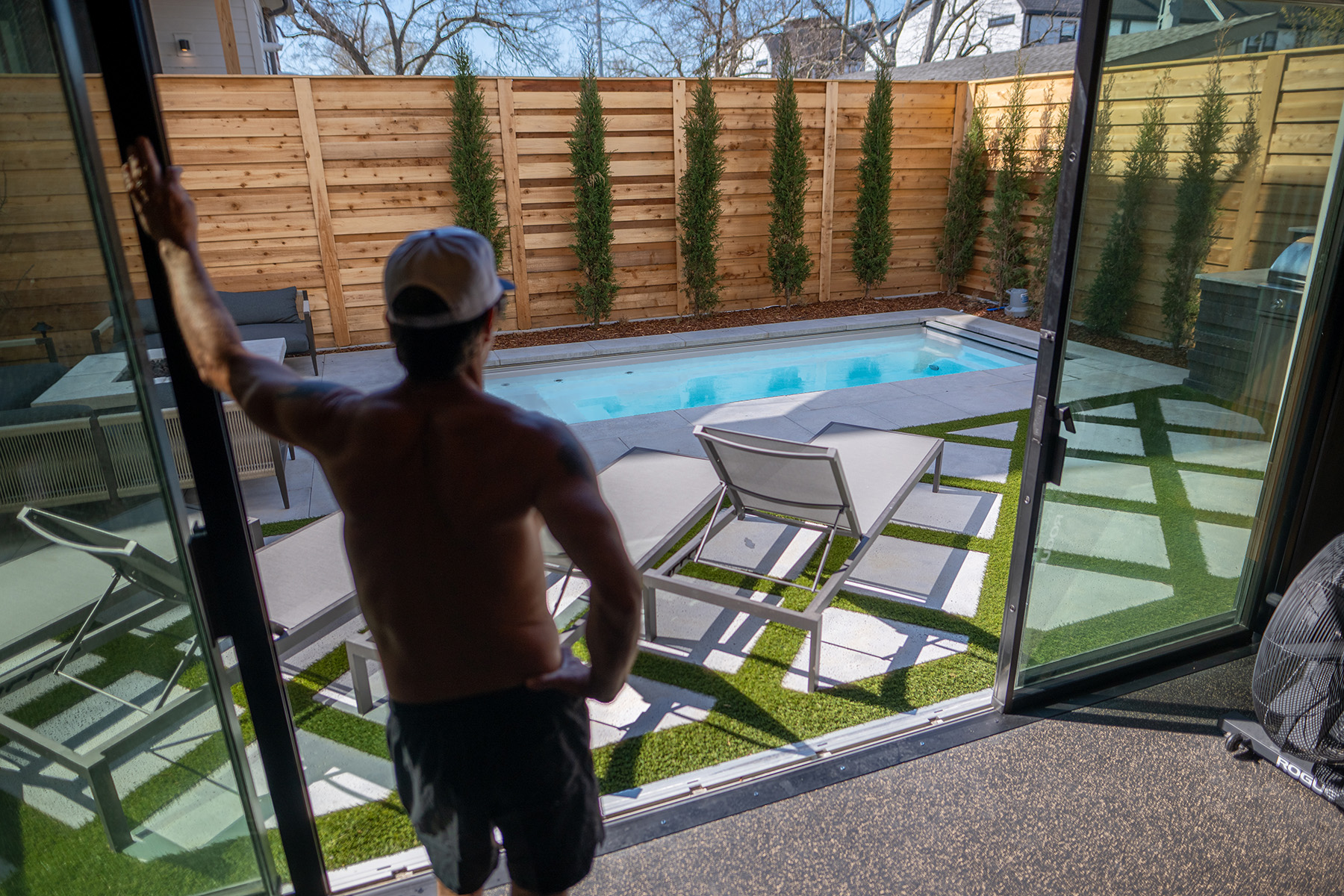
Do pools help new construction homes sell faster in Nashville? See what we're seeing with luxury builds in Green Hills, 12 South, Sylvan Park, and nearby neighborhoods.
If you're building a $2 million or $3 million spec home in Nashville, there's a point where somebody on the project is probably going to ask: Should we put in a pool? And usually, the next question is, Will we get our money back?
We understand why builders ask it. A pool, patio, landscaping, retaining walls, and the rest of the outdoor living space can represent a significant investment. If you're already carrying millions of dollars in land and construction costs, adding another major expense isn't a decision you make because a pool would "look nice." You want to know whether it helps you sell the house.
So let's get one thing out of the way first: We can't tell you that adding a pool will make your Nashville spec home sell 30, 60, or 90 days faster. The data simply isn't good enough to make that claim.
There are too many variables: price, architecture, lot size, finishes, market timing, etc.
But we're seeing something in Nashville that we think luxury home builders should pay attention to. Pools are showing up on significantly more homes. We're seeing builders plan them from the beginning. And when we talk with builders about why they're doing it, we keep hearing some version of the same answer: The house with the pool is easier to sell.
That's a different conversation than traditional pool ROI. And for a builder carrying a multimillion-dollar spec home, it may be the more important one.
Let's start with the numbers. According to Realtor.com's 2025 analysis of swimming pools in the housing market, just 7.2% of Nashville-area homes listed for sale had a pool in 2019. By 2025, that number had jumped to 25.5%.
In other words, Nashville went from roughly 1 in 14 listings having a pool to about 1 in 4. That's a significant change in just a few years.
In fact, Nashville experienced one of the largest increases among the major metropolitan areas Realtor.com studied. The analysis also noted that many cities experiencing big increases in pool listings had seen substantial new-construction activity.
Does that mean one out of every four Nashville buyers now demands a pool? Of course not. But if you're building at the higher end of the market, that's probably not the question you should be asking anyway.
The better question is: What does the house I'm building have to compete against?
Because a pool that might have felt like a special luxury several years ago is becoming a much more familiar feature in Nashville's higher-end housing market. And we're seeing that shift firsthand.
Recently, our team was involved with two pools in a three-home luxury development between Green Hills and 12 South. A different pool contractor handled the third.
So you had three high-end new homes going up side by side, representing three significant speculative investments. And all three homes got pools. They weren't treated as something a homeowner might add five years from now, or as an allowance, or even as a "pool-ready" backyard. The pool was part of the finished property from the beginning.
Even more interesting, all three homes secured buyers before construction was completely finished.
Did the pools sell those houses? We can't say that, and we'd be doing builders a disservice if we pretended we could. These were desirable Nashville homes. Architecture mattered. Price mattered. Location mattered. Finishes mattered. The builder mattered. The overall market mattered. There's no way to pull the pool out of that equation and say, "Yep, that's why they sold."
But something about the project stuck with us: nobody treated the backyard as an afterthought. The pool was simply part of what "finished" meant for these homes.
And this isn't the only project where we've seen it. During our research, we found a similar pattern in several small luxury developments around Green Hills and nearby Nashville neighborhoods. Developers weren't building several houses and putting a pool behind one. They were incorporating pools throughout the project.
When builders are putting millions of dollars into speculative homes, that behavior is worth paying attention to.
In some of the neighborhoods where we work, buyers certainly have time to be selective. Recent Redfin neighborhood data showed homes selling in approximately 60 days in 12 South, 47 days in Sylvan Park, and 77 days in Green Hills. In Green Hills, homes were selling for roughly 3% below list price on average, and more than one-third of listings had experienced a price reduction.
We don't look at those numbers and conclude that everybody needs a pool. We look at them and conclude something simpler: buyers have choices.
Imagine you're a buyer looking at two new $2.5 million homes a few streets apart. Both have beautiful architecture, high-end kitchens, great primary suites, and covered outdoor living spaces. Then you walk outside.
One backyard has a finished pool, patio, landscaping, lighting, and an outdoor space that's ready for Saturday afternoon. The other has grass.
There's nothing wrong with grass. But those buyers are being offered two very different versions of "finished." And if the buyer wants a pool eventually, the second house comes with something else: a construction project.
This is something that's easy to overlook when you're evaluating the pool strictly by its construction cost.
Let's say your buyer loves the house without the pool and figures they'll just add one later. Simple enough, right? Not necessarily.
Now they need to figure out whether a pool actually fits, whether setbacks or easements create problems, how an excavator will reach the backyard, what happens to the brand-new landscaping, whether retaining walls need to change, how stormwater will be handled, whether the home's electrical service has enough capacity, where the equipment will go, and what their beautiful new backyard is going to look like while all of this happens.
Suddenly, "We'll add the pool later" doesn't sound quite as simple.
We've encountered Nashville homeowners who want to add a pool after the house is finished only to discover that decisions made during home construction have made the project considerably more difficult. The house is there. The HVAC equipment is there. The fencing, retaining walls, and landscaping are there. Sometimes the easiest route to the backyard is simply gone.
That's especially important on tighter urban lots in neighborhoods such as 12 South and Sylvan Park. A pool that is relatively straightforward to build while the house is under construction can become a completely different project once everything around it is finished.
That's why we encourage builders to have the pool conversation early, even if they ultimately decide not to build one.
This is usually where the ROI conversation gets stuck. A builder asks, "If I spend $150,000 on the pool and outdoor living space, will I get another $150,000 when I sell the house?"
Maybe. Maybe not. We wouldn't tell you otherwise.
Pools don't operate in a vacuum, and neither do kitchens, landscaping, architecture, or high-end finishes. But for a spec builder, we think there's another way to look at the investment.
Instead of only asking how much the pool will increase the sales price, ask: Could this make my home easier for the right buyer to choose?
Those aren't the same question. And when you're carrying a multimillion-dollar spec home, the second question can have significant financial consequences.
Once construction is finished, the bills don't suddenly stop. You may still be carrying construction or acquisition financing, property taxes, insurance, utilities, landscaping, maintenance, cleaning and staging, along with a significant amount of capital tied up in the project.
And there's another cost that can be even more painful: the price reduction.
Imagine two comparable $2.5 million Nashville spec homes. One finds its buyer while construction is still wrapping up. The other finishes without a buyer and sits another 60 or 90 days. Eventually, that second builder cuts the price.
Maybe both homes ultimately sell for roughly the same amount. But those were not the same financial outcome.
That's why we don't think a pool necessarily has to add its entire construction cost to the closing price to create value for a spec builder. If the finished backyard removes an objection, separates the home from competing listings, helps attract the right buyer sooner, or reduces carrying time, some of the pool's value may never appear as a neat line item on an appraisal.
That doesn't mean you can assume the pool will accomplish those things. It simply means sales price isn't the only number worth looking at.
This is where we need to be careful. We reviewed publicly available listing information for recent Nashville new construction, and we found examples all over the place.
Some new homes with pools sold very quickly. Others sat for months. Some homes without pools presold before completion. Others sat, reduced their prices, and took much longer to find buyers. We even found nearly identical homes from the same builder where one presold almost immediately while another spent months on the market. Neither had a pool.
That's the reality of trying to answer this question with days-on-market data. There are simply too many variables.
New-construction MLS data can also be messy. A builder may list a property before it's finished, market it as Coming Soon, temporarily withdraw it, relist it, or secure a buyer while construction is still underway.
So we're not going to tell you, "Put in a pool and your house will sell 30 days faster." We can't prove that.
What we can tell you is that pools have become substantially more common in Nashville, we're seeing luxury builders incorporate them into new construction, and builders we work with repeatedly tell us that having the pool makes the finished home more marketable.
Those are different claims. And we think they're much more useful.
There's another reason we like getting involved early, and it has nothing to do with real estate comps. It's simply easier to solve problems on paper than with an excavator sitting in someone's finished front yard.
When the pool and home are designed together, we can think about the property as one project. We can work through equipment access, pool placement, drainage, electrical and gas service, retaining walls, elevations, equipment location, patio connections, and stormwater before those decisions become expensive problems.
During new construction, heavy equipment may already have access to the property. The site is being graded anyway. Utilities can be planned. Retaining walls can be coordinated. Hardscape elevations can work together. Landscaping can go in once.
That last one sounds small until you've watched somebody tear out landscaping they paid to install six months earlier so we can get equipment into the backyard. Nobody enjoys that conversation.
A lot of these headaches can be avoided with a relatively simple decision: talk about the pool before the site plan is finished.
Absolutely not. There are homes where we'd tell the builder it doesn't make sense.
Price point matters. Neighborhood matters. The lot matters. The target buyer matters. The overall construction budget matters. And sometimes the site itself gives you the answer.
If adding the pool forces compromises to the house, creates an awkward backyard, blows up the budget, or doesn't fit the likely buyer, don't build one simply because pools are becoming more popular. That's not the argument we're making.
Our argument is much narrower: If you're building a high-end speculative home in Green Hills, 12 South, Sylvan Park, or a similar Nashville neighborhood, the pool deserves to be evaluated while you're designing the property, not after the house is nearly finished.
You can always decide not to build it. But once the house, utilities, HVAC, retaining walls, driveway, fencing, and landscaping are installed, some of your options may disappear with them.
When a builder brings us into a project early, we're looking at much more than where a rectangle could fit in the backyard.
We start with access. Can excavation equipment actually reach the backyard? Then we look at setbacks, utility easements, drainage easements, and other restrictions that can dramatically change the usable area.
Stormwater is another major consideration. The additional impervious surface needs to work within the property's overall drainage and stormwater plan. We also need to understand where electrical and gas service will come from, how the pool and patio elevations relate to the house and surrounding grade, and whether retaining walls need to be incorporated into the design.
Then there's the equipment itself. Where can it go so it functions properly without becoming an eyesore or negatively affecting an otherwise beautiful outdoor living space?
None of those are particularly glamorous questions. But they're the questions that determine whether the finished backyard actually works.
And we'd much rather answer them on a set of plans than after construction.
If you're looking for us to say yes every time, we won't. Sometimes the answer is no.
But if you're putting a significant amount of capital into a luxury spec home in Green Hills, 12 South, Sylvan Park, or another high-end Nashville neighborhood, we think ignoring the pool until the end of the project is a mistake.
Not because we can promise you'll recover every dollar. Not because we can promise the home will sell faster. And certainly not because every luxury buyer wants a pool.
It's because the market is changing. More Nashville homes have pools than they did several years ago. We're seeing luxury builders include them from the beginning. And we're hearing builders talk less about the pool as an optional backyard amenity and more about it as part of delivering a complete property.
So maybe the question isn't, "Will I get every dollar I spend on this pool back?"
Maybe it's, "When my buyer is standing in this backyard and then standing in the backyard of the house down the street, which home is easier to say yes to?"
For a spec builder, that may be the more valuable question.
One of the most useful conversations we can have with a builder happens long before anyone starts digging a pool.
Give us the site plan and let us look at access, setbacks, elevations, utilities, drainage, retaining walls, and where the equipment would need to go. Then we can tell you what we're seeing.
At Nashville Dip Pools, we work with builders on new-construction projects throughout Nashville, including the smaller urban lots common in neighborhoods like Green Hills, 12 South, and Sylvan Park.
Sometimes that conversation leads to a pool. Sometimes it leads to changes that make a future pool possible. And sometimes the right answer is, "Don't put a pool here."
That's still a useful answer.
Because the best time to discover whether a pool belongs on the property isn't when the landscaping is finished and the house is ready to sell. It's while you still have options.
Monday–Saturday: 8 AM to 7 PM. Special appointments available upon request.



Monday–Saturday: 8 AM to 7 PM Special appointments available upon request.